
Warehouse packaging work is often framed as an e-commerce story, but the 2026 data tells a broader one. Groceries, medicine, electric vehicles, and semiconductors now pull packaging and fulfillment labor just as hard as online retail does. This report maps how major U.S. industries shape demand for warehouse packaging workers, region by region — from the Inland Empire's import gateway to the EV and battery plants of the Sun Belt — and breaks down the pay, hiring pressure, and automation trends defining the year.
Why Warehouse Packaging Demand Is No Longer Just an E-Commerce Story
Ask most people what keeps a warehouse packaging line busy, and they will say online shopping. That answer is only partly right. In 2026, the workers who tape boxes, build pallets, and label freight are being pulled in by a much wider set of industries — groceries, medicine, electric vehicles, and computer chips among them. U.S. retail e-commerce sales reached $326.7 billion in the first quarter of 2026, about 16.9% of all retail spending and up 9.8% year over year. Yet e-commerce is now one engine among several.
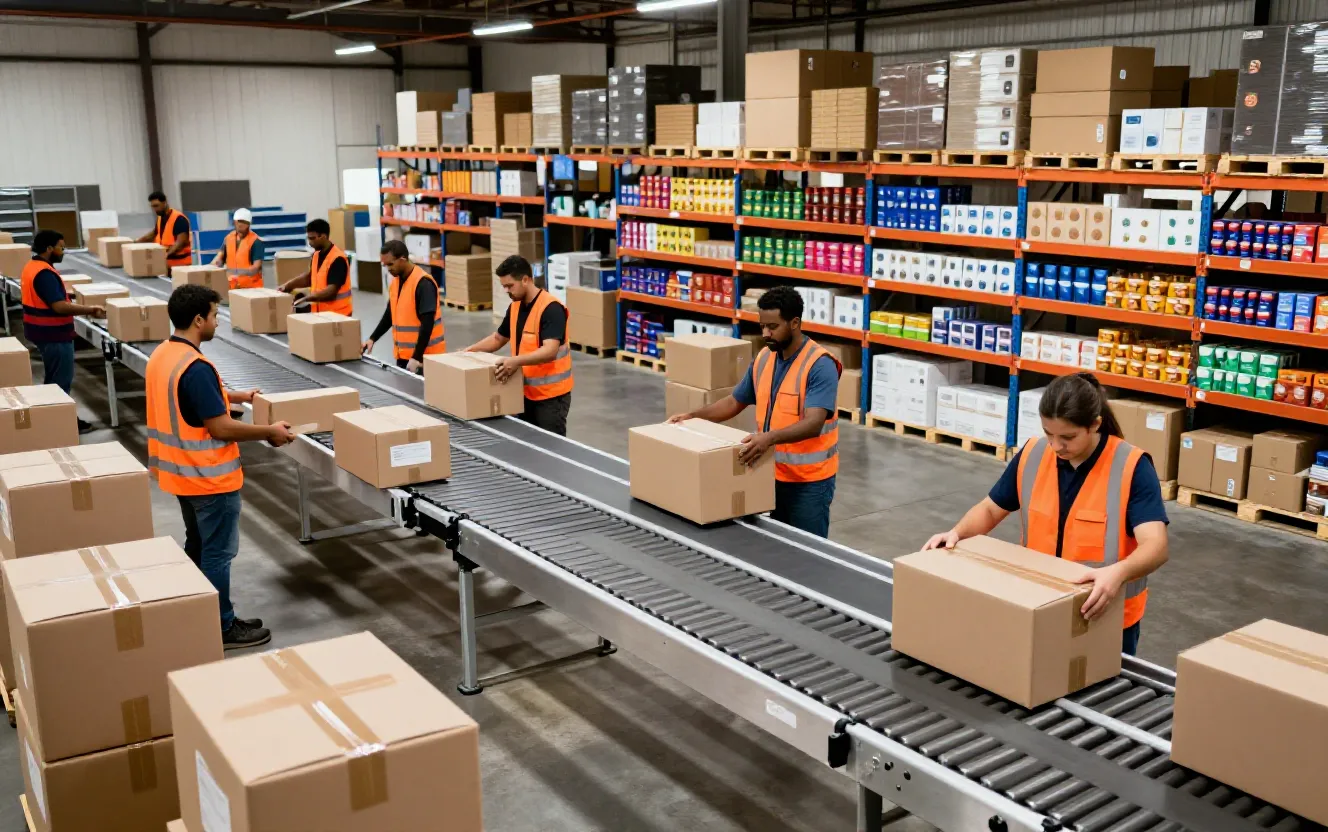
The industrial real estate behind those jobs keeps expanding. National industrial vacancy fell to 6.8% in the second quarter of 2026, leasing activity climbed to 175.7 million square feet (up 49.4% year over year), and average asking rents hit $10.45 per square foot. Roughly 276 million square feet of industrial space is under construction — square footage that will eventually need staff to run it.
The 2026 Industry Demand Map: Who Is Hiring Packaging Workers
Packaging labor demand rises and falls with the industries that ship physical goods. Five sectors dominate in 2026, and each one shapes the kind of packaging work available.
E-Commerce and Retail Fulfillment
Online retail still drives the highest volume of pick, pack, and label roles. With e-commerce growing roughly 2.5 times faster than total retail, fulfillment centers continue to add packaging shifts even as automation spreads.
Food, Beverage, and Cold Chain
Food and beverage remains the single largest warehousing and distribution segment, and cold-chain packing is expanding alongside demand for fresh produce, seafood, dairy, and ready-to-eat meals. This work skews toward palletizing, date coding, and temperature-controlled handling.
Pharmaceuticals and Healthcare
Pharma is the fastest-growing cold-chain segment. Biologics and mRNA-based products require ultra-cold storage and compliant packaging, driving demand for workers trained in serialization labeling and temperature-controlled packing.
Automotive, EV, and Battery Manufacturing
EV and battery plants spreading across the Sun Belt generate component kitting and heavy-duty crating work. Michigan and Georgia are the clearest examples, where new battery facilities pull packaging and materials-handling labor into industrial corridors.
Consumer Electronics and Semiconductor Supply Chains
New fabrication plants in Arizona, Idaho, and North Carolina create specialized, high-value packaging roles — ESD-safe packing and precision handling that demand more training than standard parcel work.
Industry2026 Demand SignalPackaging Role It DrivesE-commerce / retail$326.7B Q1 online sales; 16.9% of retailPick, pack, label, returns processingFood & beverageLargest warehousing & distribution segmentCold-chain packing, palletizing, date codingPharmaceuticalsFastest-growing cold-chain segmentTemperature-controlled packing, serializationAutomotive / EVBattery and EV plants across the Sun BeltComponent kitting, heavy-duty cratingElectronics / semiconductorsNew fabs in AZ, ID, NCESD-safe packing, high-value handling
Regional Demand: How Local Industry Mix Shapes Packaging Jobs
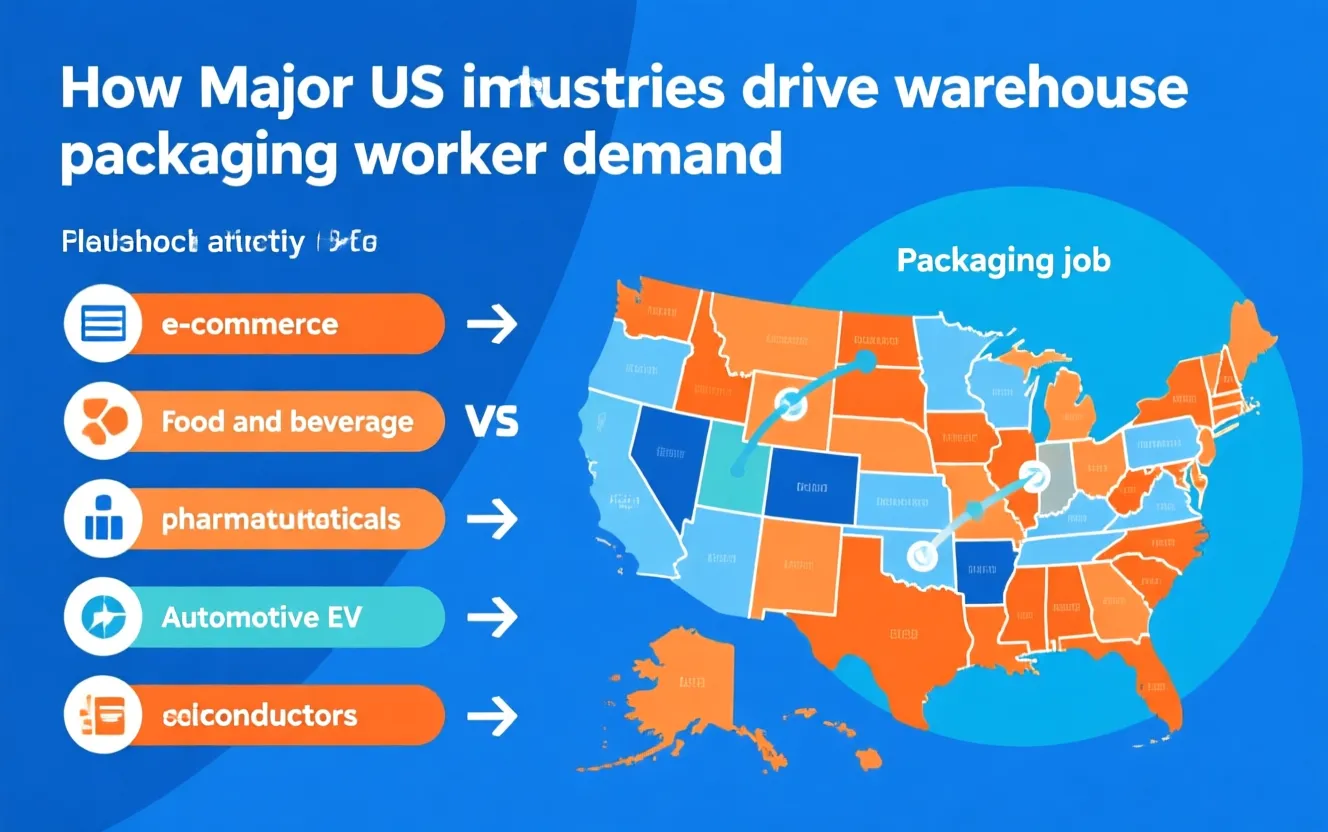
Warehouse packaging demand is not spread evenly across the country. It clusters where specific industries concentrate — and each region's industry mix determines whether the work is cold-chain, heavy crating, or high-volume parcel packing.
Inland Empire and Southern California
Southern California remains the country's largest distribution gateway, and import volume keeps packaging and fulfillment shifts busy. But 2026 has been uneven: California WARN filings show Geodis cutting 238 jobs at its Rialto center, CJ Logistics eliminating 71 positions in Fontana, and Eclipse Advantage closing its Rancho Cucamonga facility. Riverside County's unemployment rate stood at 5.1% in March 2026 and San Bernardino's at 5.0% — signs that the region's packaging demand is normalizing after years of rapid growth.
Texas (Dallas–Fort Worth, Houston)
Central location and fast population growth make Texas a magnet for food and beverage, consumer goods, and e-commerce distribution. New fulfillment and sortation sites feed national routes, sustaining steady packaging and palletizing demand.
Southeast (Georgia, Florida, Tennessee, North Carolina)
Georgia has become the South's manufacturing powerhouse, attracting EV, battery, and aerospace facilities. North Carolina's biotech and pharmaceutical cluster adds cold-chain packing demand, while Atlanta and Memphis act as logistics anchors.
Midwest (Ohio, Indiana, Kentucky, Michigan)
Michigan's EV-battery reinvestment and the rail and interstate crossroads of Louisville, Columbus, and Hebron keep heavy industrial and warehousing demand strong through 2026.
Northeast (Pennsylvania, New Jersey, Maryland)
Dense metro delivery demand drives parcel packing and cross-docking across eastern Pennsylvania and New Jersey, with Hagerstown and Shippensburg serving as key distribution hubs.
Pacific Northwest and Mountain West
Semiconductor and solar manufacturing around Phoenix and Reno, plus the Pacific Northwest's air hub, create specialized packaging roles. Arizona is forecast to add roughly 18,000 to 24,000 manufacturing and warehousing jobs in 2026.
RegionDominant IndustriesPackaging Demand Outlook 2026Inland Empire / SoCalImport retail, e-commerceHigh volume, but cooling amid layoffsTexasFood & beverage, consumer goods, e-commerceSteady and geographically expandingSoutheastEV, battery, pharma/biotechRising, especially cold-chain packingMidwestAutomotive/EV, rail distributionStrong industrial and warehouse mixNortheastMetro parcel deliveryStable, driven by dense demandPacific NW / Mountain WestSemiconductors, solar, air freightSpecialized, high-value packing
Pay, Hiring Pressure, and the Automation Overlay
Packaging and warehouse roles remain some of the hardest positions to fill. 78% of facilities report difficulty hiring and retaining qualified warehouse staff, roughly 500,000 warehouse and logistics jobs sit open in the United States, and annual turnover runs near 36%. Pick-and-pack workers, forklift operators, and shift leads are the most difficult to staff.
Pay reflects that pressure. The average warehouse worker earns about $18.20 per hour in 2026, with most roles landing between $15 and $24 per hour. Employers are also spending more on automation: average annual materials-handling investment has climbed toward $402,000, with 14% of companies planning $1 million or more. DHL is deploying more than 1,000 additional robots, and Ryder has automated nearly 40% of its network.
Metric2026 FigureWhat It MeansAverage warehouse hourly pay~$18.20Baseline for packaging rolesTypical pay range$15–$24 / hourVaries by region and shiftFacilities struggling to hire78%Persistent labor gapOpen warehouse/logistics jobs~500,000Year-round opportunityAnnual warehouse turnover~36%Constant rehiringAvg. materials-handling spend~$402,000Automation rising
What This Means for Employers and Job Seekers
The clearest takeaway from the 2026 data is that packaging demand follows industry, not just geography. A region anchored in pharma needs cold-chain packers; one built around EV plants needs crating and kitting crews; a major import gateway needs high-volume parcel packers. Understanding that mix is what separates operations that stay staffed from those that scramble.
For employers, the practical move is to match local labor to the region's dominant industries — and to treat packaging roles as year-round positions rather than seasonal fill-ins. For job seekers, the strongest opportunities sit where two or more of these industries overlap, since that overlap keeps shifts running even when one sector cools.
Whether you are staffing a fulfillment center or looking for steady packaging work, start by studying your region's industry mix. Employers comparing reliable contractors in my area can match local crews to the right sector — cold-chain teams for pharma, crating crews for EV plants, and high-volume parcel packers for e-commerce — instead of hiring generically and hoping the fit holds.